
Developing Arduino sketches with JetBrains CLion: A minimal example.

The official Arduino Desktop IDE is fantastic at what it was made for. After downloading, opening your first sketch (say, blink.ino) and flashing this to your connected Arduino hardware takes all of 3 seconds.

However, once your sketches become a little more complex, a more sophisticated IDE with code navigation, documentation and context-sensitive completion can be a great help.

Currently, one of the better solutions is the Arduino extension for Visual Studio Code. You can be up and running quite quickly, and after adding the necessary include directories to your config, the built-in IntelliSense C++ helps immensely with code completion, navigation and inline documentation.
Which jumper to set on the ITEAD XBee shield v1.1 for use with a 3.3V Arduino

I had to use the ITEAD Studio XBee shield v1.1 with an Arduino m0 (SAMD21) board, which is a 3.3V board, whereas the most common Arduinos are 5V.

At the time of this writing, the shield’s website was not very clear on how exactly to set the jumpers (zone 5: “When operated in 3.3V, install the jumper” — which one?!), and the rest of the internet also did not seem to know.

Use the Google Cloud Speech API to transcribe a podcast

As I was listening to the December 21 episode of the CPPCast, together with TWiML&AI my two most favourite podcasts, I couldn’t help but be a little bewildered by the number of times the guest used the word “like” during their interview.

Most of these were examples of speech disfluency, or filler words, but I have to admit that they detracted somewhat from an otherwise interesting discourse.

During another CPPCast episode which I recently listened to, the hosts coincidentally discussed the idea of making available transcriptions of the casts.

Creating a Django migration for a GiST / GIN index with a special index operator.

In order to add a GiST index on a Postgres database that could be used to accelerate trigram matches using the pg_trgm module and the special gist_trgm_ops operator, I had to code up a special Django Index

Django will hopefully soon support custom index operators, but if you need the functionality right now, this example will do the trick.

The special GiST index class looks like this:

from django.contrib.postgres.indexes import GistIndex

class GistIndexTrgrmOps(GistIndex): def create_sql(self, model, schema_editor): # - this Statement is instantiated by the _create_index_sql() # method of django.db.backends.base.schema.BaseDatabaseSchemaEditor. # using sql_create_index template from # django.db.backends.postgresql.schema.DatabaseSchemaEditor # - the template has original value: # “CREATE INDEX %(name)s ON %(table)s%(using)s (%(columns)s)%(extra)s” statement = super().create_sql(model, schema_editor) # - however, we want to use a GIST index to accelerate trigram # matching, so we want to add the gist_trgm_ops index operator # class # - so we replace the template with: # “CREATE INDEX %(name)s ON %(table)s%(using)s (%(columns)s gist_trgrm_ops)%(extra)s” statement.template =
“CREATE INDEX %(name)s ON %(table)s%(using)s (%(columns)s gist_trgm_ops)%(extra)s”

Variational Autoencoder in PyTorch, commented and annotated.

I have recently become fascinated with (Variational) Autoencoders and with PyTorch.

Kevin Frans has a beautiful blog post online explaining variational autoencoders, with examples in TensorFlow and, importantly, with cat pictures. Jaan Altosaar’s blog post takes an even deeper look at VAEs from both the deep learning perspective and the perspective of graphical models. Both of these posts, as well as Diederik Kingma’s original 2014 paper Auto-Encoding Variational Bayes, are more than worth your time.

How to debug PyInstaller DLL / PYD load failed issues on Windows

TL;DR

When debugging DLL load errors on Windows, use lucasg’s open source and more modern rewrite of the old Dependency Walker software. Very importantly, keep on drilling down through indirect dependencies until you find the missing DLLs.

The Problem

Recently I had to package up a wxPython and VTK-based app for standalone deployment on Windows. Because of great experience with PyInstaller, I opted to use this tool.

With the first try with the freshly built package on the deployment machine, it refused to start up due to an ImportError: DLL load failed: The specified module could not be found., and specifically with the vtk.vtkCommonCorePython.pyd Python extension DLL.

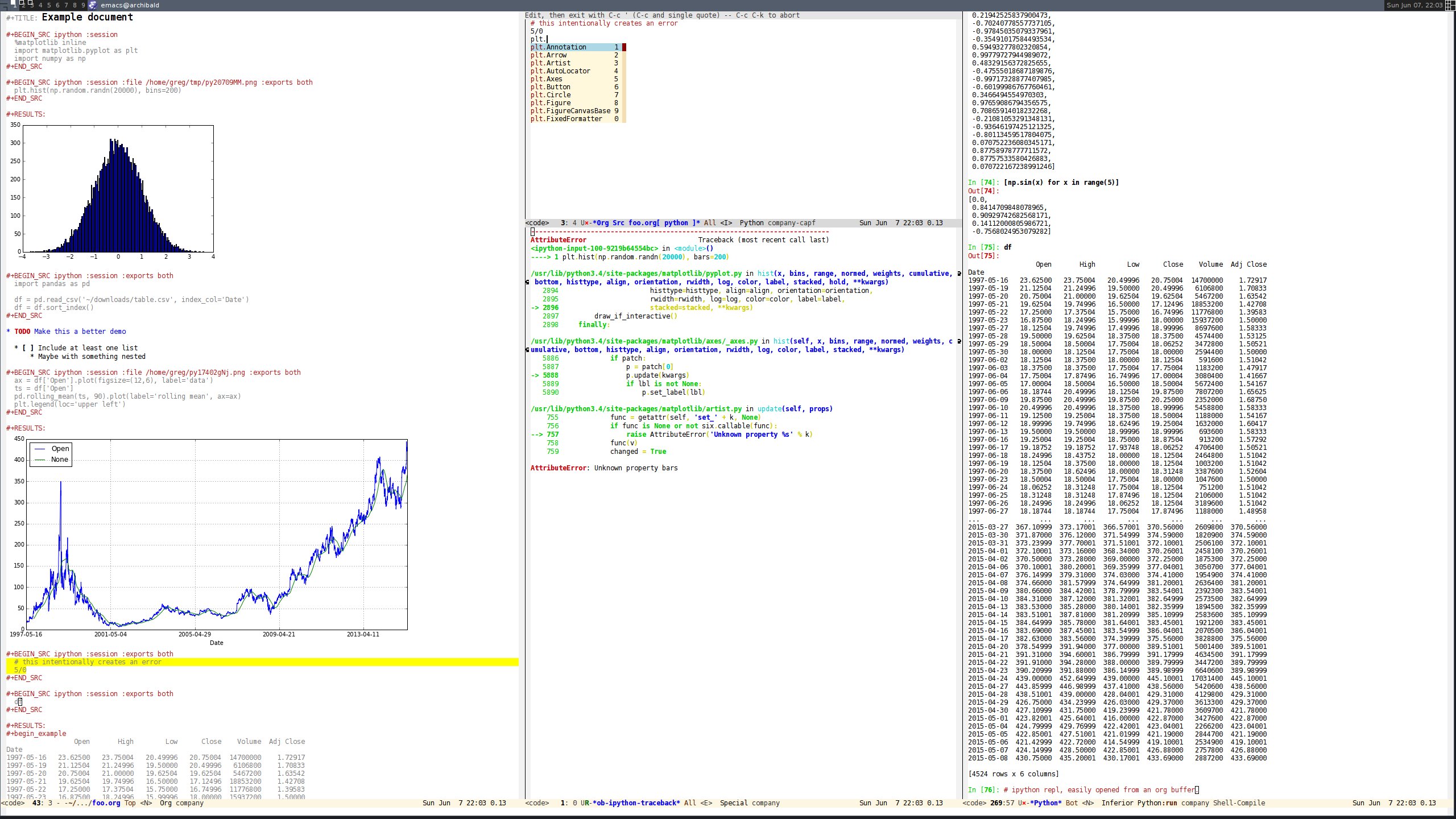
Run code on remote ipython kernels with Emacs and orgmode.

As is briefly documented on the ob-ipython github, one can run code on remote ipython kernels.

In this post, I give a little more detail, and show that this also works wonderfully for remote generation but local embedding of graphics in Emacs Org mode.

As I hinted previously, the jupyter notebook is a great interface for computational coding, but Emacs and Org mode offer far more flexible editing and are more robust as a documentation format.

If you want to run OpenGL 3.2+ apps in a Windows guest, AVOID Parallels 13 and buy VMWare Fusion 10 instead.

TL;DR: Parallels Desktop 13 only supports OpenGL 3.2 on an extremely limited subset of mostly games. VMWare Fusion 10 has full OpenGL 3.3 support. In my case, this made the difference between being able to work on a VTK-based client project (VMWare Fusion 👍👍) or NOT being able to work the project (Parallels 👎👎).

I bought a Parallels Desktop Pro 13 subscription to be able to do Linux and Windows development on my MacBook Pro.

Getting ob-ipython to show documentation during company completion.

ob-ipython is an Emacs package that enables org-babel to talk to a running ipython kernel. The upshot of this is that you can use org-mode instead of the jupyter notebook for interspersing executable code, results and documentation.

The screenshot from the ob-ipython github shows it in action: ob-ipython-github-screenshot.jpg

Personally, I would like to use this for controlling ipython kernels on remote GPU- and deep learning-capable Linux machines, all via Emacs on my laptop. The juyter notebook is really fantastic, but it’s not Emacs.

The RobotDyn Joystick shield has the XBee TX / RX lines switched to D0 and D1 or completely disconnected

RobotDyn offers a well-manufactured Joystick and XBee shield for the Arduino Uno which I am currently using for some IEEE 802.15.4-related experiments.

However, as it is not mentioned in any official documentation, I want to document here that the XBee TX / RX lines are connected to the Arduino D1 and D0 lines respectively and can only be disconnected via the “USB sketch update / Wireless” hardware switch at the top left: